Can Invisalign fix crooked teeth? For most people, yes. Clear aligners handle crowding, spacing, tipped and rotated teeth well, and they now treat a considerably wider range of cases than they did a decade ago. What they do not do is remove the need for a diagnosis, because “crooked teeth” describes an appearance rather than a problem, and two mouths that look similar can need entirely different treatment. If you are looking at Invisalign in Box Hill, Hawthorn, or the surrounding suburbs, this is what aligners do well and where they struggle.
Key takeaways
- Crowding, spacing and mild to moderate rotations are well within what aligners correct.
- Severe rotations, large vertical movements, and skeletal bite problems are where fixed appliances have the advantage.
- Crooked teeth are usually a space problem. How that space is created matters more than the appliance.
- Attachments are what make aligners work on difficult teeth, and they are more visible than the trays.
- A short cosmetic course and comprehensive treatment are different products. Know which you are being offered.
What “crooked teeth” usually means
In most cases it means crowding: there is more tooth than there is arch to hold it, so teeth overlap, rotate, and displace to fit. Less often it means spacing, where teeth have drifted apart, or a single tooth that erupted out of position.
The distinction matters because crowding is a space problem, and the treatment question is where the space is going to come from. There are three sources, and they are not interchangeable.
Expansion. Widening the arch to create room. This works well where the arch is genuinely narrow, and it is limited by the bone available. Pushing beyond that bone risks gum recession, which is why expansion is planned from imaging rather than applied by default.
Interproximal reduction. Removing very small amounts of enamel between the teeth to create room. The Cleveland Clinic overview of interproximal reduction describes it as a less invasive alternative to extraction. It is permanent but conservative, and it suits mild to moderate crowding.
Extraction. Removing teeth, usually premolars, where crowding is severe. Less common than it once was, and still the right answer in some cases.
Which of these your case needs is a diagnostic decision. It is not determined by whether you choose aligners or braces.
Can Invisalign fix crooked teeth? What aligners do well
- Crowding, mild through to moderate and often severe, given a suitable space plan.
- Spacing and gaps, which aligners close predictably.
- Tipped teeth, corrected by uprighting them.
- Mild to moderate rotations, particularly on incisors.
- Relapse cases, where someone had braces years ago and stopped wearing retainers. These are among the most satisfying aligner cases because the teeth have been in the right place before.
- Mild to moderate bite corrections, usually with elastics.
Where fixed appliances still do better
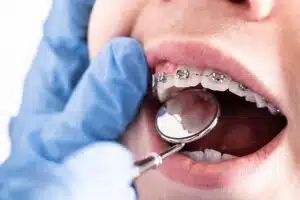
- Severe rotations, particularly canines and premolars, which have long roots and resist turning.
- Large vertical movements, such as significantly intruding or erupting a tooth.
- Closing extraction spaces, where teeth must be moved bodily rather than tipped.
- Skeletal bite discrepancies, which need auxiliaries or surgical planning.
- Impacted teeth that must be guided into the arch.
- Patients who will not wear them. Aligners work only while in the mouth. For a younger teenager who will not comply, fixed braces are the honest recommendation, and a good orthodontist will say so.
|
Clear aligners |
Fixed braces |
|
|
Crowding and spacing |
Excellent |
Excellent |
|
Severe rotations |
Harder. Needs attachments and sometimes fixed assistance |
Better control |
|
Extraction space closure |
Less efficient |
More efficient |
|
Appearance during treatment |
Discreet, though attachments are visible |
Visible, ceramic reduces this |
|
Cleaning |
Easier. Removed to brush |
Harder |
|
Depends on patient compliance |
Entirely |
Not at all |
|
Diet restrictions |
None. Trays come out |
Hard, sticky and chewy foods restricted |
The part people are not told: attachments
Almost every comprehensive aligner case uses attachments, small tooth coloured shapes bonded to individual teeth that give the tray something to grip. Without them, a smooth plastic tray simply slides over a rounded tooth and cannot rotate it.
They are more visible than the aligner itself. Patients who choose aligners expecting invisibility are often surprised, particularly when several attachments sit on the front teeth. They are removed at the end of treatment and leave no trace, but it is worth knowing beforehand rather than at the fitting appointment.
Elastics are the other visible component in bite correction cases, running between the arches from bonded buttons or tray cut-outs.
Timelines
Simple cases involving mild crowding or a small gap frequently finish within six to twelve months. Comprehensive treatment is more commonly twelve to twenty-four months, which is comparable with fixed braces for equivalent complexity.
What sets the timeline is the amount of movement required and the consistency of wear, in that order. Aligners need twenty to twenty-two hours a day, which leaves roughly two hours for all meals and cleaning combined. Falling behind on wear time is the single most common reason a plan overruns.
Refinement stages at the end, where a further short series of trays details the result, are normal and usually anticipated in the plan rather than evidence that something went wrong.
Short cosmetic courses versus comprehensive treatment
This is the distinction most worth understanding before you compare quotes.
A short course aligns the visible front teeth. It is quicker and less expensive, and for someone whose only concern is mild front tooth crowding or relapse, it can be entirely appropriate.
Comprehensive treatment corrects the bite as well: how the upper and lower arches meet, where the roots sit, and how force is distributed when you chew. It takes longer and costs more.
The problem arises when a short course is presented as equivalent to comprehensive treatment. The front teeth look straighter, and the bite is unchanged, which for a patient whose crowding was caused by a bite problem, means the result is unstable. Ask explicitly which you are being offered.
Retention, which is not optional
After treatment, the ligament suspending each tooth and the bone around it need a prolonged period to reorganise at the new position, and until they do, the teeth carry a real tendency to drift back. That tendency is strongest in the first year.
Retainers are worn full time initially and then at night, and that night wear continues indefinitely rather than for a fixed period. It is a small ongoing commitment set against one to two years of active treatment, and it is the difference between keeping the result and repeating the work. Relapse after discontinuing retention is one of the most common reasons adults seek treatment a second time.
Virtuosum Orthodontics in Melbourne
Dr. Sean O’Callaghan leads the practice, which uses Invisalign, SureSmile and SureAlign alongside fixed braces, with i-CAT imaging for three-dimensional assessment. Virtuosum is a Platinum Invisalign provider and a faculty member of SureSmile, with over thirty-five years of experience behind the practice.
Two clinics serve the eastern suburbs: 244 Barkers Road, Hawthorn VIC 3122, and 37 Warrandyte Road, Ringwood VIC 3134, both on 1300 678 461. The practice also provides orthodontics for children and lingual orthodontics. General background on orthodontic care is available from the American Association of Orthodontists and on braces from the American Dental Association.
Frequently asked questions
Can Invisalign fix crooked teeth?
For most people, yes. Aligners correct crowding, spacing, tipped teeth, and mild to moderate rotations well. Severe rotations, large vertical movements, extraction space closure, and skeletal bite discrepancies are where fixed appliances retain an advantage. A consultation and records establish which category your case falls into.
How long does it take?
Mild crowding or a small gap often finishes in six to twelve months. Comprehensive treatment is more commonly twelve to twenty-four months, comparable with braces for equivalent complexity. The amount of movement required and how consistently you wear the trays are what determine it.
Where will the space come from if my teeth are crowded?
One of three sources: expanding the arch, removing very small amounts of enamel between teeth, or extracting teeth in severe cases. Which is appropriate depends on how much space is needed and how much bone is available, and it is decided from imaging rather than from preference.
Are aligners as effective as braces?
For the cases they suit, yes. For severe rotations, extraction space closure and skeletal bite correction, fixed braces give the orthodontist more direct control. The more useful question is which your particular bite needs, and an orthodontist who will tell you honestly when aligners are the wrong tool is worth more than any general comparison.
Will I need attachments?
Almost certainly for comprehensive treatment. They are small tooth coloured shapes bonded to individual teeth that give the trays grip, and without them aligners cannot rotate a rounded tooth. They are more visible than the trays themselves, and they are removed at the end, leaving no trace.
How many hours a day do I have to wear them?
Twenty to twenty-two, every day. That leaves about two hours for all meals and cleaning combined, which is tighter than most people expect. Trays come out for all food and any drink other than plain water, and teeth are brushed before they go back in.
What is the difference between a short course and full treatment?
A short course aligns the visible front teeth. Comprehensive treatment also corrects the bite, root positions, and how force is distributed when chewing. A short course is appropriate for mild front tooth crowding or relapse, and inappropriate where the crowding was caused by a bite problem. Ask which you are being offered.
Do I have to wear retainers afterwards?
Yes, indefinitely. Teeth carry a real tendency to drift back, strongest in the first year after treatment, because the ligament and bone need a long period to reorganise. Retainers are worn full time initially and then nightly on an ongoing basis.
Is there an age limit?
No. Teeth move by the same biological process at seventy as at seventeen, and suitability depends on the health of the gums and supporting bone. Adults do bring specific considerations, including no remaining growth and often existing restorative work, but neither rules out treatment.
Can crooked teeth cause problems if I leave them?
Crowded and overlapping teeth are harder to clean, which raises the long-term risk of decay and gum disease. A bite that meets unevenly wears some teeth faster than others and can load the jaw joint. Whether that warrants treatment is a judgement made on your specific case rather than on appearance.
Considering Invisalign in Box Hill, Hawthorn or Ringwood? Virtuosum Orthodontics will tell you what aligners can achieve for your bite and where braces would do better. Ring 1300 678 461.